
The Structured Build

You’ve probably done this before, or watched a colleague do it. Here’s how it usually goes.

Everybody agrees on the kickoff call. Then it goes quiet for six weeks. When you finally see something, it’s a finished course, and it’s wrong. Now you’re rewriting a thing that’s already built, three weeks out from a date you can’t move.

The quiet part is where it breaks. You’re waiting. I’m working. Neither of us knows we’re picturing different things.

So I don’t work that way. Every phase of this ends with a document you read and mark up. You always know where the project is, because you’re holding the last thing I made.

Two clients called this work “structured” before I ever called it anything. I took the word from them.

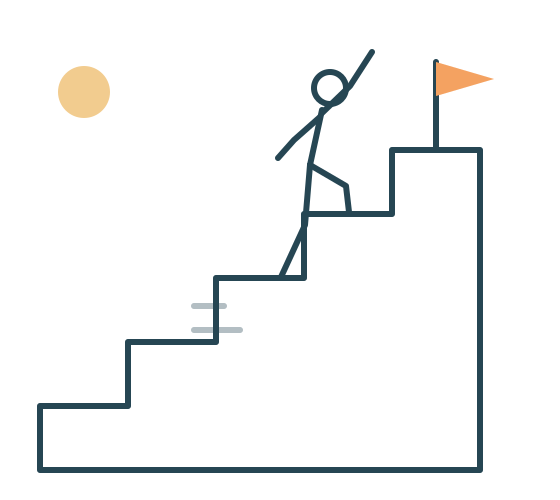
A figure climbs a 5-step staircase with one hand raised, toward a flag planted at the top

The five phases

Phase 1. Discovery

I read everything you already run. The deck, the facilitator guide, the policy nobody’s opened since 2023. I want the parts that aren’t filed anywhere, too. The thing your best trainer always says out loud that never made it into the slides.

Then I ask you the one question your material can’t answer. After somebody takes this course, what should they do differently? And who’s going to notice?

Then comes the hard part, which is cutting. A day in a room doesn’t become a day at a desk. Half of what works live only works because a person was reading the room. Somebody has to say what goes, and on your subject that’s a real decision with real consequences, so you make it. We do it in week 2, on paper, while it’s cheap.

You get a Course Plan. Who it’s for, what it has to do, how it’s built, what got cut and why, and how I’m handling accessibility. Short enough to read in one sitting. Specific enough to argue with. When somebody turns up in week 9 with opinions, this is what you hand them.

Phase 2. Design

This is the one that matters.

I write your whole course out as a document first. Every screen, in order. What it says. What the narration says. What happens when somebody clicks. Every quiz question, every wrong answer, and what they see when they pick it. Where each image goes and what it has to show.

Then you read it. The whole thing.

I’m not going to pretend that’s a small favor. It reads like a long report, and it’ll cost you an afternoon you don’t have. It’s the biggest thing I ask of you.

But you’re the only person who can catch what I need caught. You know the words your staff actually use. You know that scenario would never happen at your sites, and this one happens every Tuesday. You know the line somebody added to the policy last year. None of that shows up in a picture of a screen.

So you mark it up. Change a line, kill a screen, tell me the manager in scenario 3 would never talk like that. Right now that costs me a paragraph. After I’ve built it, it costs the screen, the narration, and the file that goes to your LMS.

You get a Storyboard. The whole course on paper, screen by screen.

Phase 3. Build

This part should be boring, and I work at keeping it boring.

I build what you approved, in Rise or Storyline. Nothing new turns up. No screen you didn’t read. No question with a different answer. If something in the build surprises you, that’s a bug and I’ll fix it.

Accessibility goes in while I’m building, not after. We already settled all of it in phase 1.

You get a Review Build. A real, working course on a link you can send around.

Phase 4. Review

Two rounds, included. I don’t sell them back to you later.

Consolidated just means you send me one list. You gather what everybody said, you decide what’s in and what’s out, and I work from your list. That’s more work for you. It’s also how you stay in charge of your own project instead of refereeing an email thread.

Two rounds is enough because we already had the hard conversation in phase 2. These rounds are for what nobody could catch on paper. A transition that reads fine and plays slow. One click too many. A term your director wants changed.

If a review round turns into a redesign, phase 2 failed. I’ll tell you so, and I won’t bill you for fixing it.

You get a Final Build. Corrected and signed off.

Phase 5. Handover

Most vendors keep the source files. Nobody says that out loud on a sales call, but it’s how a one-time project turns into a permanent dependency. Every small change after that has to come back through them, at their rate, on their calendar.

I hand it all over. Published files for your LMS, the editable source, and the IP, on final payment. Change it yourself next year. Hand it to somebody else. It won’t turn into a fight.

You get a Handover Package. Everything, in a form somebody who isn’t me can open.

One person, all five

Same person the whole way, and that’s not about staffing. Whoever read your facilitator guide in week 1 is the person building screen 40 in week 12. That’s why your language is still there at screen 40. Nothing gets handed off and translated on the way.

The gate

You approve the whole course on paper before I build a single screen of it.

Everything else here is just doing the work carefully. This is the part almost nobody does. It drags the moment of truth from week 14 up to week 5, and week 5 is exactly when a vendor is least sure of themselves and most tempted to show you something shiny instead.

It also means I can’t hide. A storyboard is the least flattering document in this business. No design, no animation, no interface to carry it. Just the words and the thinking, in a plain font, where you can count them.

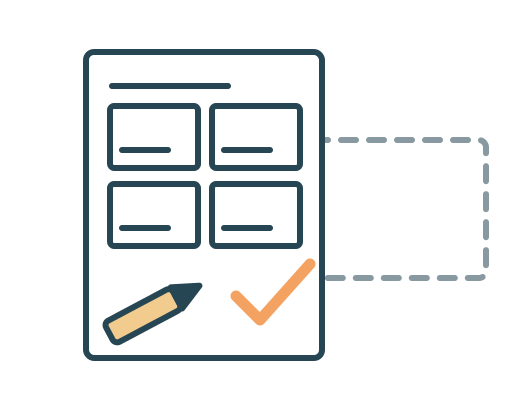
A storyboard on paper with four screens sketched on it, a pen, and a large check mark, standing in front of a screen drawn in dashes because it has not been built yet
A person reading closely, pen in hand, thinking something over

Accessibility

Decided before anything gets built

Accessibility gets decided in the Course Plan, before anything is built. Fixing it afterward costs up to five times more, and it shows.

In phase 1 I write down the answers to five things, and you can hold me to them. How somebody gets through the course on a keyboard. What a screen reader says. Whether the video is captioned and transcribed. What every image has to say when nobody can see it. Whether color is doing work on its own.

Those answers change what I build. If a drag-and-drop can’t be done from a keyboard, I don’t build a drag-and-drop. Bolting it on later gives you a course that technically passes and is still miserable to use, usually for the exact people it got added for.

If you’ve got a legal obligation, or a funder who asks, you’ll have the answer in writing from week 2.

Build sizes

How big is it, and how long does it take

Three sizes. I’ll tell you which one you’re in after Discovery, once I’ve seen what you’ve actually got. Nobody’s guessing on a first call.

Focused Build.

One course, one source, about 30 finished minutes.

8 to 12 weeks.

Standard Build.

One course, several sources, SME time, about 45 to 60 finished minutes.

12 to 16 weeks.

Program Build.

Multiple modules, SME interviews, 2 to 3 finished hours.

20 to 26 weeks.

The short end of each range assumes your material is in decent shape and your reviewers write back. Those are the two things that actually move a date, and they’re both on your side of the table. That’s not a dig. It’s just true.

There are no prices on this site. Tell me what you’ve got and when it has to be live. When I write a proposal, it has a fixed scope and a fixed date on it.

Course Care

Phase 6, after handover

A course goes live. A year later the policy changes, or somebody renames a role, or a video shows a process that doesn’t exist anymore. Nobody owns the fix. Whoever built it has moved on. So the course just stays wrong, and people keep taking it.

Course Care is a yearly arrangement. A set number of edit hours, one accessibility check, and I move you to the front of the line when something has to change by a date.

It’s optional, and it isn’t the point of the project. It’s here because a course that’s still right a year from now is worth more than one that was right on launch day.

Starting with a Course Plan

The smaller way in

You don’t have to buy the whole build to find out what you’re dealing with.

You can buy phase 1 on its own. I run Discovery, you get the Course Plan, and it’s yours no matter what you do next. Take it to your board. Take it to another vendor and get a real quote against a real scope. Put it in a drawer until next year’s budget.

It’s paid, and if you go ahead with the build, it comes off the price.

Most people should just use the form. But if what’s stopping you is that you can’t describe the project well enough to buy it yet, start here.

The three guarantees

In the contract, in these words

  1. You approve the full course on paper before I build a single screen. There’s no version of this where you see the finished course for the first time and it’s wrong.
  2. The person on your first call is the person who builds it. Named in the contract.
  3. Source files and IP are yours on final payment.

I’m Denise Robinson, and those are mine to keep.

Where this starts

Tell me what you already run, who has to take it, and the date you can’t move. That’s enough to start. You’ll hear back from me within one business day.